Introduction
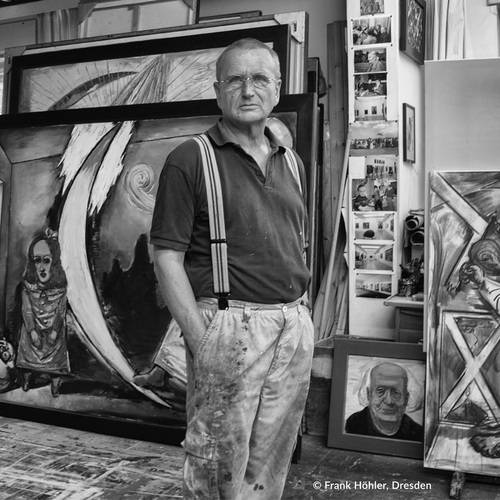
The Dresden-based painter and draftsman Hubertus Giebe is one of the leading figures of expressive figurative painting among the younger postwar generation of German artists. Since the 1980s, his name has been well known in the East and West German art scenes, and since the 1990s at the latest, it has also gained international recognition; today, he occupies a prominent position in contemporary painting. The exhibition “Crescent Moon” aims to trace the artistic credo of the painter and intellectual, as well as the genesis of his incomparable body of work, through a selection of key exhibits.
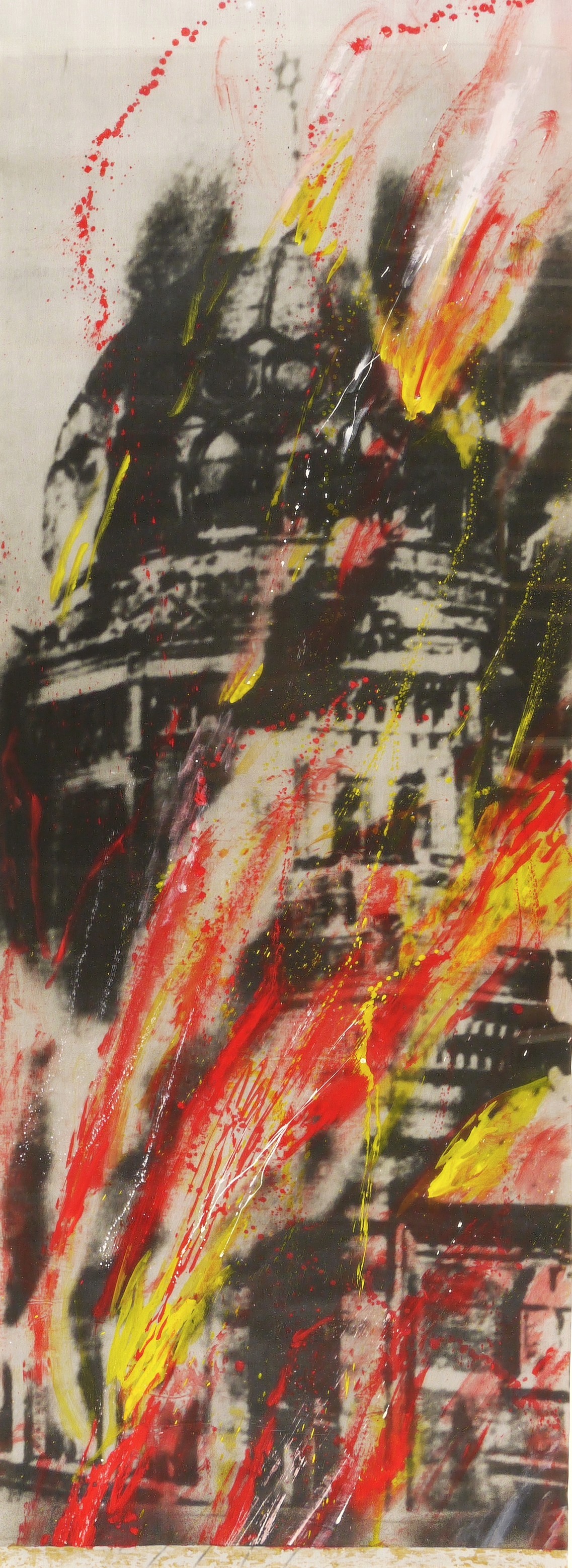
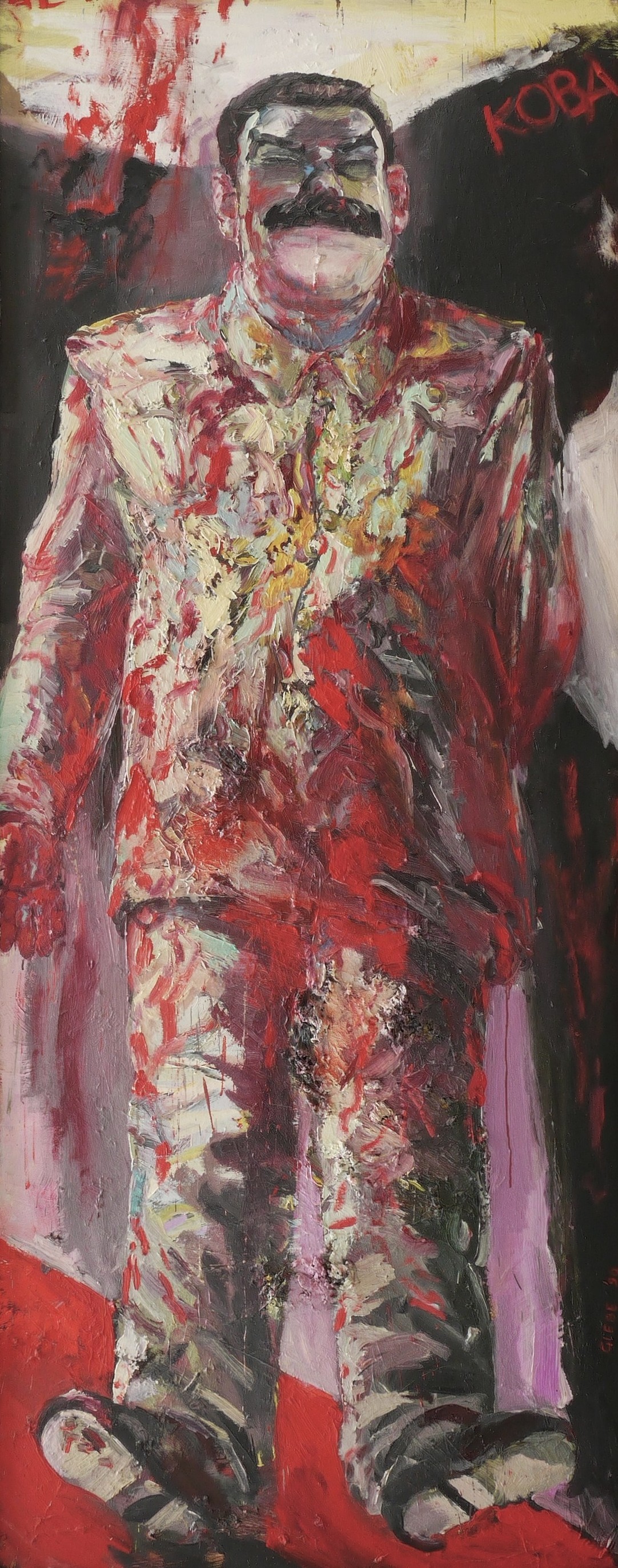
The focus is on allegorical “historical paintings,” which can be understood as concise yet richly contrasting parables about our world and its often oppressive history. “Historical Banners,” which were on view as a pictorial-spatial installation at the 44th Venice Biennale in 1990, are juxtaposed with the portrait of Joseph Stalin (1990), an apocalyptic-seeming Pietà (“Black Picture,” 1993), and the harrowing scenario “The Dream” (1997). In addition, the early oil paintings “Soldier’s Portrait” and “Barracks Room,” both from 1973, bear witness to Giebe’s longstanding engagement with the themes of war and suffering. All these images are highly relevant today and speak of inner states of mind and struggle, of grappling with the world and history, and not least of the absolute necessity of art.
Time and again—this time with what is now his seventh solo exhibition—we surround ourselves with the figures of Giebe’s “World Theater,” confronting the creatures and visual symbols created by his brush. They were and remain the central focus of his work: sometimes doll-like, sometimes endangered figures, seemingly brutal fragments, bizarre objects, and symbolic signs populate evocative, horror-stricken scenes that the artist, acting as a director, conjures up and forces into confined pictorial spaces.
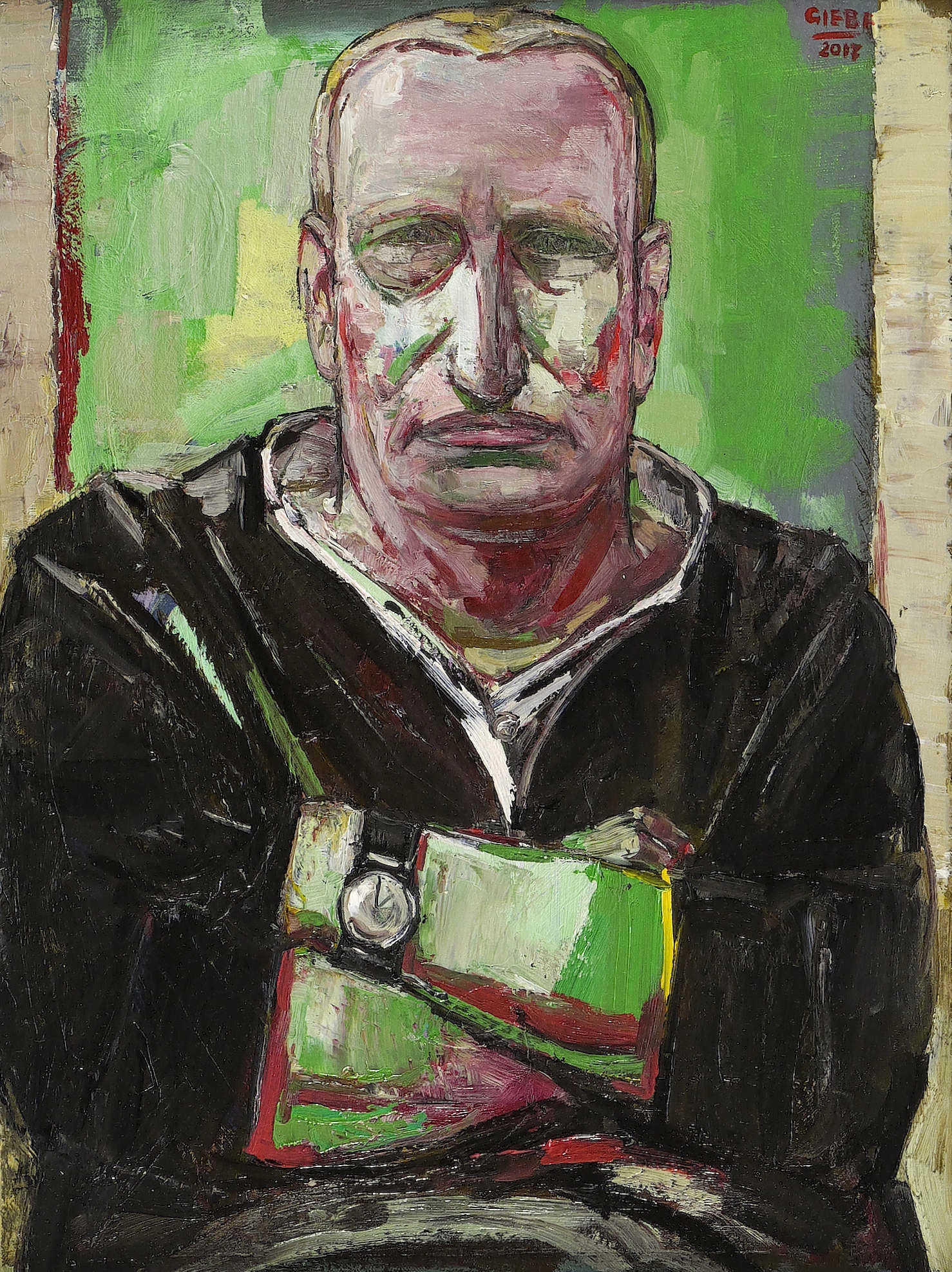
Apart from his Sisyphean labor on the “picture of history,” Hubertus Giebe formulates a visual language no less forceful, no less demanding in traditional subjects such as the portrait, the nude, the landscape, or the still life—a language defined by the same expressive style, the same powerful coloration, the same reduction of form, and the same sharpening of contours. Time and again, dynamic movement and shimmering, luminous colorism encounter dull rigidity and shattering stillness. In this, his kindred spirits are Oskar Kokoschka, Max Beckmann, and Otto Dix.
Hubertus Giebe’s visual worlds probe the depths of our humanity, unmasking and questioning our society through paintings that have become visual admonitions or lamentations. Yet while this painting addresses our humanity, it never succumbs to rhetoric foreign to art, but speaks the pure language of painting, follows its laws alone, and measures itself against the greatest of its craft.