Aquarell, 53,0 x 29,0 cm
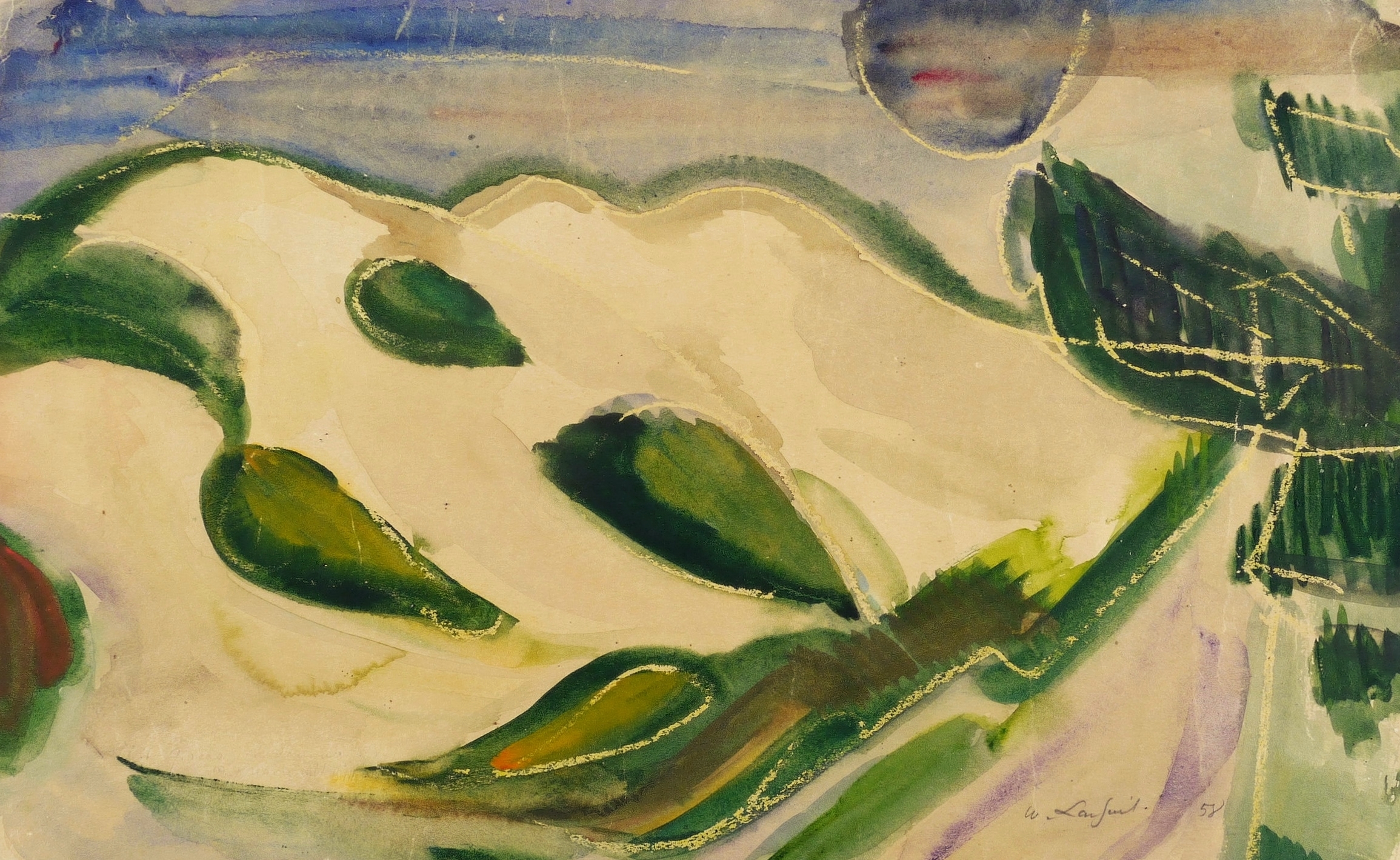
Aquarell, 25,0 x 40,5 cm

Aquarell, 30,0 x 40,0 cm
Wilhelm Lachnit is one of the most important figures in 20th-century Dresden art. His artistic career began in the 1920s, when he was one of the co-founders of New Objectivity in Dresden. From 1947 to 1953, he served as a professor of painting at the Dresden Academy of Fine Arts. Classicism and beauty, as well as imagination and humor, define the themes of Wilhelm Lachnit’s paintings, particularly his depictions of figures, circus scenes, still lifes, and landscapes.


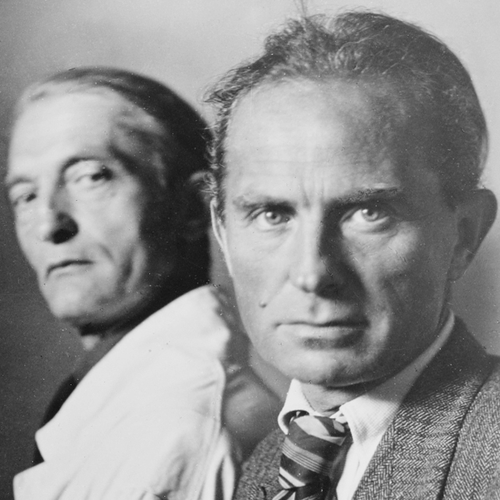
| 1899 | born on November 12 in Gittersee near Dresden as the third child of carpenter Wilhelm Lachnit and his wife Emma Martha Lachnit |
|---|---|
| 1914-1918 | Apprenticeship as a Sign Painter and Varnisher |
| 1918-1920 | worked as a decorative painter; attended evening classes at the Dresden School of Applied Arts; studied in the studio and outdoors under the guidance of Georg Oehme; joined the »Dresden Secession - Group 1919«, founded in 1919 |
| 1921-1923 | Studied painting and graphic arts at the Dresden Academy of Fine Arts under Richard Dreher, and subsequently became one of his master students; became acquainted with Otto Dix, Otto Griebel, Conrad Felixmüller and Curt Großpietsch |
| 1923 | Graduated with honors; works as a freelance artist |
| 1924 | Member of the »Red Group«; represented with five works at the First General German Art Exhibition in Moscow, Leningrad, and Saratov; the Hermitage in Leningrad acquires the painting »Dresden Railroad Overpass« |
| 1925 | Joined the KPD; co-founder of the »Neue Gruppe« with Hans Grundig, Fritz Skade and Otto Griebel |
| 1926 | Participated in the first International Art Exhibition in Dresden with two paintings; the painting »Girl with a Fur Coat« was acquired by the Dresden City Art Gallery; additional works were acquired by the Kupferstich-Kabinett and the Dresden City Museum; met Fritz Löffler; Resignation from the »Dresden Secession-Group 1919« together with Hans Grundig, Otto Griebel, Eugen Hoffmann, Bernhard Kretzschmar, Wilhelm Rudolph and Fritz Skade in protest against the bourgeois art world |
| 1927 | Participation in an Exhibition in Paris |
| 1928 | Participation in the German Art Exhibition in Düsseldorf |
| 1929 | Co-founder of the Dresden chapter of the »Association of Revolutionary Visual Artists of Germany« (ASSO); participation in the exhibition »New Objectivity« in Amsterdam; trips to southern France, Italy, and North Africa |
| 1930 | Participation in the exhibition »Socialist Art Today« in Amsterdam |
| 1931/32 | Large-format woodcuts |
| 1933 | Four drawings are confiscated as »degenerate art«; imprisonment; after his release, he is placed under Gestapo surveillance; largely excluded from the art world; he creates works with metaphorical messages about the painful experience of isolation and existential threat, such as »Sad Spring«; occasional work as an exhibition and trade show designer |
| 1945 | in January, he was drafted into the »Volkssturm« as part of the Jungbunzlau State Rifle Battalion; on February 13, most of his work was destroyed during the bombing of Dresden |
| 1946 | artistic exploration of the postwar period (»The Death of Dresden«); represented with seven works at the General German Art Exhibition in Dresden |
| 1947-1954 | Professor of Painting at the Dresden Academy of Fine Arts; students include Peter Bock, Manfred Böttger, Helmut Gebhardt, Harald Metzkes, Dietrich Becker and Jürgen Böttcher |
| 1954 | after years of defamation and disciplinary action by the university, he resigned from his professorship; since then, he has been working as a freelance artist in Dresden; he experiments with graphic techniques, particularly aquatint and color monotypes |
| 1955/56 | Commission to design the entrance gates of the student dormitory at the former Technical University; trip to Italy with Karl Kröner |
| 1960 | So-called »threat scenarios« emerge; begins work on the »Source« series using various techniques; suffers his first heart attack |
| 1961 | is working in Berlin on designs for an enamel mural for the cafeteria at the Construction Workers' Center in Frankfurt/Oder |
| 1962 | Wilhelm Lachnit dies on November 14 in Dresden as a result of a second heart attack; he is buried at the Dresden-Loschwitz Cemetery |
This comes from Wilhelm Lachnit's paintings – a harmony, but as they said in Dresden, a harmony in Catholic colours. He cooled down the Baroque with the cold water of Classicism. He wanted to create images of life that went beyond mere observation, capturing, organising and taming demonism, glamour and smell. What lay behind the eyes, in the brain, was to be included – the ornament.
Lachnit did not want to create copies, he strove for spiritualisation and metaphorical representation of things. He achieved nuanced colourfulness, increasing solidity and tectonics, compositional density and sublimated expressiveness. There is no tendency towards dissolution of form, even in his most abstract works. Only in his late monotypes can an opening towards Informel be observed.
| 1924 | First General German Art Exhibition, Moscow, Leningrad and Saratov (Participation) |
|---|---|
| 1926 | First International Art Exhibition, Dresden (Participation) |
| 1927 | Collection of German Art, Paris (partnership) |
| 1928 | German Art Exhibition, Düsseldorf; traveling exhibition through American cities (participation) |
| 1929 | Stedelijk Museum, Amsterdam: “New Objectivity” (Participation) |
| 1930 | Stedelijk Museum, Amsterdam: “Socialist Art. Today” (Participation) |
| 1932 | 1. Exhibition of the Dresden Secession 1932, Saxon Art Association. Dresden (Participation) |
| 1946 | General German Art Exhibition, Dresden (Participation) |
| 1958 | Albertinum, 4th German Art Exhibition, Dresden (Participation) |
| 1960 | Museum am Anger, Erfurt: »Wilhelm Lachnit: Paintings, Drawings, Prints« |
| 1961 | Wort und Werk Gallery, Leipzig |
| 1965 | Dresden State Art Collections, Gallery of New Masters, Albertinum |
| 1967 | Leonhardi Museum, Dresden |
| 1977 | Dresden State Art Collections, Dresden Cabinet of Prints |
| 1979 | Berlin State Museums |
| 1989 | Gallery of the Dresden Academy of Fine Arts |
| 1990 | Berlin Academy of Arts, in the New Marstall |
| 1999 | Friedenstein Castle Museum, Gotha |
| 2000 | Villa Eschebach, Dresden. Exhibition Marking the 100th Anniversary of his Birth |
| 2011 | Dresden City Gallery: »Refuge and Melancholy« |