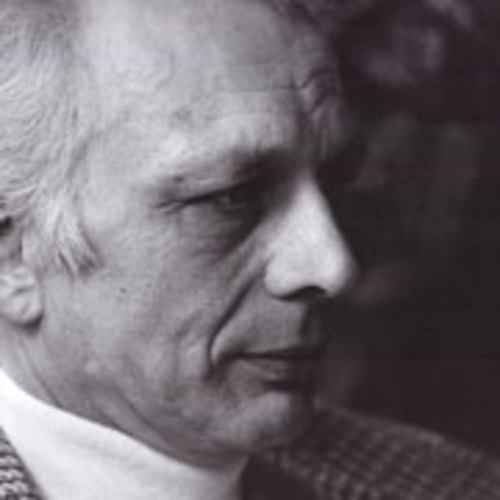
As part of his large-scale project »Idee Konkrete Zeichnungen«, Manfred Luther created several groups of works. In the ink drawings and silkscreen prints of the »Paraphrases«, created between 1970 and 1985, Manfred Luther combines simple geometric shapes – such as squares, triangles, and circles – in ever-changing variations, revealing – despite the rigor of the forms – an extraordinary joy in experimentation and a passion for composition.
Luther, Manfred. – Konkrete Zeichnungen III. – Paraphrasen Schwarz-Gelb. – „Paraphrase (Dreieck im Quadrat in 9 Reihen)”
Luther, Manfred. – Konkrete Zeichnungen III. – „Paraphrase 18”
Luther, Manfred. – Konkrete Zeichnungen III. – „Paraphrase 15”
Luther, Manfred. – Konkrete Zeichnungen III. – „Paraphrase 16”
Luther, Manfred. – Konkrete Zeichnungen III. – Paraphrasen Schwarz-Weiß. – „Paraphrase 44 (133 weiße und schwarze Halbkreise)”
Luther, Manfred. – Konkrete Zeichnungen III. – „Paraphrase 19”
Luther, Manfred. – Konkrete Zeichnungen III. – „Paraphrase 21”
Luther, Manfred. – Konkrete Zeichnungen III. – „Paraphrase 20”
Luther, Manfred. – Konkrete Zeichnungen III. – „Paraphrase 26”
Luther, Manfred. – Konkrete Zeichnungen III. – „Paraphrase 5”
Manfred Luther is an exceptional figure in constructive-concrete art, a field he unmistakably opened up to conceptual art through his intellectual and philosophical approach. In his 1960/61 manifesto »Idee Konkrete Zeichnungen« (Idea Concrete Drawings), he elevated the geometric figure to a symbol of thought, a metaphor for his universal insights derived from the synthesis of the natural and human sciences. Through the combination or isolated presentation of basic geometric figures across several groups of works beginning in 1983, he ultimately developed the circular images of the series »Cogito ergo sum« as both the culmination and the core of his artistic concept. In terms of the foundation of a philosophical concept – the interwoven unity of idea and image – Manfred Luther stands alongside only A.R. Penck and Carlfriedrich Claus within the context of East German modernism.
Böhlitz, Michael (Hrsg.). – „Manfred Luther. Paraphrasen”.
2026. Galerie Himmel (Eigenverlag), Dresden. – Ausstellungskatalog, von Manfred Luther. – 21 x 21 cm (Format).
8°, Broschur, 100 S., 48 Kat.-Abb., 6 Text-Abb. – Katalog zur Ausstellung ″Manfred Luther. Konkrete Meditationen″ in Kooperation mit dem Künstlernachlass in der Galerie Himmel in Dresden, 21.11.2026-23.01.2027. – Texte von Michael Böhlitz und Zsófia Kelm. – Ausführlicher Katalogteil mit 48 Werken des Künstlers aus den Jahren 1970 bis 1985. – Erstausgabe, neu.
The work of the Dresden-based constructivist and philosopher Manfred Luther represents one of the most independent positions in Concrete Art and Conceptual Art in Germany. Going beyond mere abstraction or decorative geometry, Manfred Luther understood artistic creation as the result of pure, radical thought processes. Thus, between 1960 and 1968, he produced his manifesto »Idee Konkrete Zeichnungen«, based on a set of six geometric figures, and an initial group of »24 Tuschzeichnungen« (24 ink drawings), which depicted these figures, either individually or in simple combinations with other figures.
The »Paraphrases« were created during a creative phase that followed immediately afterward and reveal Luther at a fascinating juncture in his artistic and philosophical exploration. While the »24 Tuschzeichnungen« elevated the geometric figure to a symbol of thought in its purest essence, the »Paraphrases« that followed beginning in 1970 broke with this strict order in order to reexamine the concept of »Idee Konkrete Zeichnungen« and expand upon it through a kind of calculated play.
The drawings and silkscreen prints of the »Paraphrases« open up a seemingly inexhaustible compositional space through variation and transposition, and through the interplay of form between system and deviation. Following the laws of serial combinatorics – through sequencing, branching, and repetition, as well as rhythmic shifts, reflections, and superimpositions – the geometric figures unfold an almost magical dynamism. The sharp contrast between black and white or black and yellow draws the eye to structure and movement in both plane and depth.
From the perspective of the aesthetics of artistic development, Manfred Luther's »Paraphrases« appear as a compellingly logical and, at the same time, poetic link in his lifelong journey from the systematic variations on his basic figures to the ultimate symbol of knowledge: the circle. In the series »Cogito ergo sum«, he advanced toward the central component of his »Idee Konkrete Zeichnungen« by condensing and focusing on the circle.
While the circles and the »24 Tuschzeichnungen« exude a meditative, almost sacred austerity, a distinctly playful gesture emerges in the »Paraphrases«. Therein lies their fascination, for they liberate the elementary system, develop a pronounced dynamism, and invite the eye to follow the serious play and harmony of the forms. Unlike the virtual kinetics in Victor Vasarely's work, which overwhelms and deceives the eye, Luther's »Paraphrases« are quieter, more poetic, and more profound; they do not produce Op Art patterns but rather leave room for cognitive experience and comprehension.
Manfred Luther,
Paraphrase (Dreieck im Quadrat in 9 Reihen), 1970
Zeichnung / Tusche, 71,7 x 53,8 cm