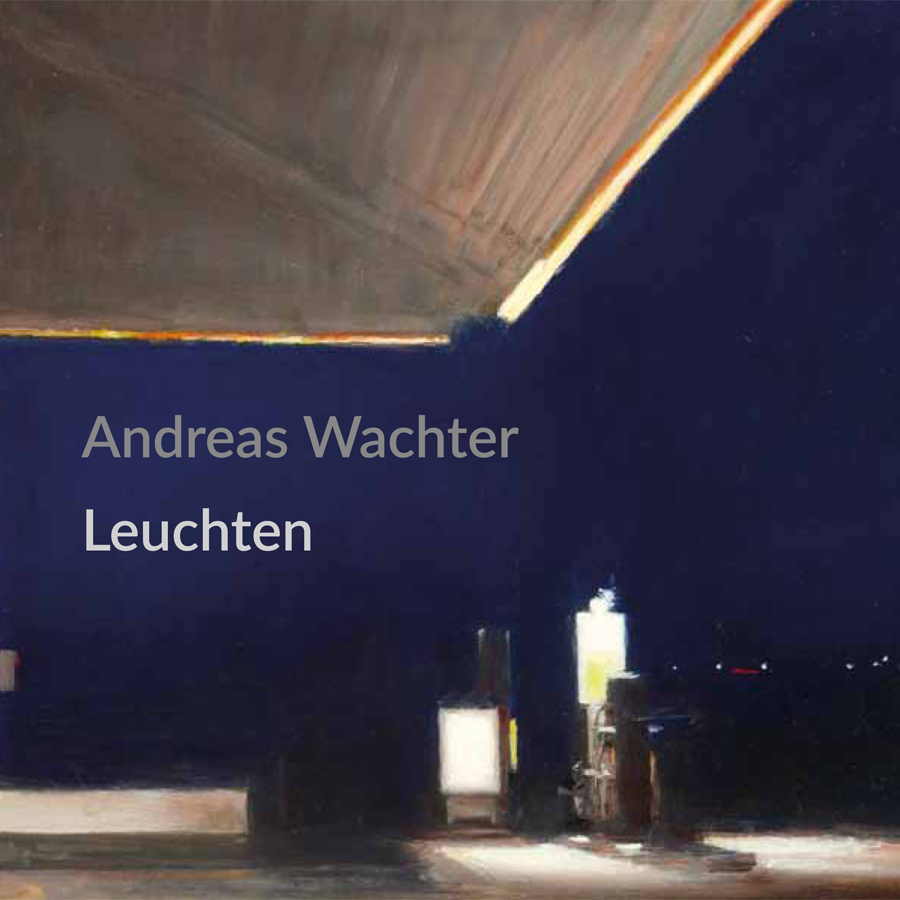
Daring compositions, striking lighting effects, a stimulating colour concept and, last but not least, a virtuoso, technically brilliant style characterise Andreas Wachter's painting. Born in Chemnitz in 1951, he is now considered one of the outstanding representatives of the »Leipzig School«. In his work, which has grown steadily over four decades, he combines the high standard of drawing typical of Leipzig with an extraordinary colourism of his own.
Böhlitz, Michael / Himmel, Anja (Hrsg.). – „Andreas Wachter. Leuchten”.
2020. Galerie Himmel (Eigenverlag), Dresden. – Ausstellungskatalog, von Andreas Wachter. – 21 x 21 cm (Format).
8°, Broschur, 88 S., 59 Abb. – Katalog zur Ausstellung ″Andreas Wachter. Leuchten″ in der Galerie Himmel in Dresden, 23. Oktober 2020 - 16. Januar 2021. – Vorwort von Anja Himmel und Michael Böhlitz, Text von Paul Kaiser. – Erstausgabe, neu.
Like others of his generation born in 1951, the painter Andreas Wachter stands between the second and third generations of the Leipzig School, roughly between Arno Rink and Neo Rauch, to put it in terms of names. And Andreas Wachter has turned this special position, this wedging between the formative generations, into a solitary power centre. This may also have been possible because, wise in his constellation, he did not move his creative base to Leipzig's music quarter, thus avoiding making the upheavals at the Academy of Visual Arts part of his own biography. Much has been said and even more written about the picturesque grandeur of Andreas Wachter, a master who now lives in Freiberger Mulde of all places. Some kind words have also been said about his art-historical references to Venetian Mannerism, his skilful mastery of scenic chiaroscuro dramaturgy, and his baroque momentum of passion. These are characteristics that undoubtedly apply to the painter, but are just as much a part of the core identity of the Leipzig School as a whole. However, this list of peculiarities could be continued with the parallel sequences of selected motif landscapes that can be perceived in his work. On the one hand, there are the spaces of longing. Motifs that were both loved and hated by artists from Leipzig. Those, as in the case of Wachter, who were followed by tireless on-site studies between Sicily and Rome after the so-called »Wende« (German reunification). These produced a knowledge of the world that was preceded by sensual observation. This is evident artistically, for example, in the topos of the beach image. By insisting on the beach as an imaginary backdrop and border space, Leipzig painting overlaid the harsh rupture of the system change with an artistic continuum. Thus, today we are in the fortunate position of experiencing, with Andreas Wachter, artistic contrasts that range from the beaches of the island Rügen to those of the Aeolian Islands. But for observers interested in clarity, this may remain an external event. On the other hand, what is important and in Wachter's case probably more secure is the connection to supportive basic structures. As with so many painters of the Leipzig School, their focus is essentially on an artistic marriage. This overlap of private and collective causalities found institutional acceptance in the Leipzig School, translating art history into family histories and vice versa. In keeping with this spirit, we also find family tableaux in the programmatic paintings of this exhibition. This thematisation of the immediate environment does not take place in hidden symbolism, as a substitute for models, so to speak, but rather in the firm belief that in this only seemingly small slice of life, the whole miracle of existence may shine much more clearly than in many of the historical panoramas that became a trademark for other Leipzig artists. However one may interpret the success of the so- called »New Leipzig School«, whose protagonists ultimately form the fourth generation in the complex of the »Leipzig School«: their success did not arise from the favour of new circumstances, as some simple-minded people believe, but rather, on the contrary, from the inspiring view into the arsenal of old or even just older almost forgotten old or even just older painters. As an important bridge figure between the Leipzig generations, Andreas Wachter helped to preserve this attitude towards painting and its material. He did this by holding fast to what was immutable for him in the midst of change. His unwavering devotion to the human figure with its bizarre, sublime or even just everyday moments offers no sense of flat recognition, but rather the chance to recalibrate his compass needle again and again in the maelstrom of life – even if north then remains south.
Dr. Paul Kaiser, Dresden
Andreas Wachter,
Sonnenberg, 2020
Mischtechnik auf Holz, 245 x 183 cm