Introduction
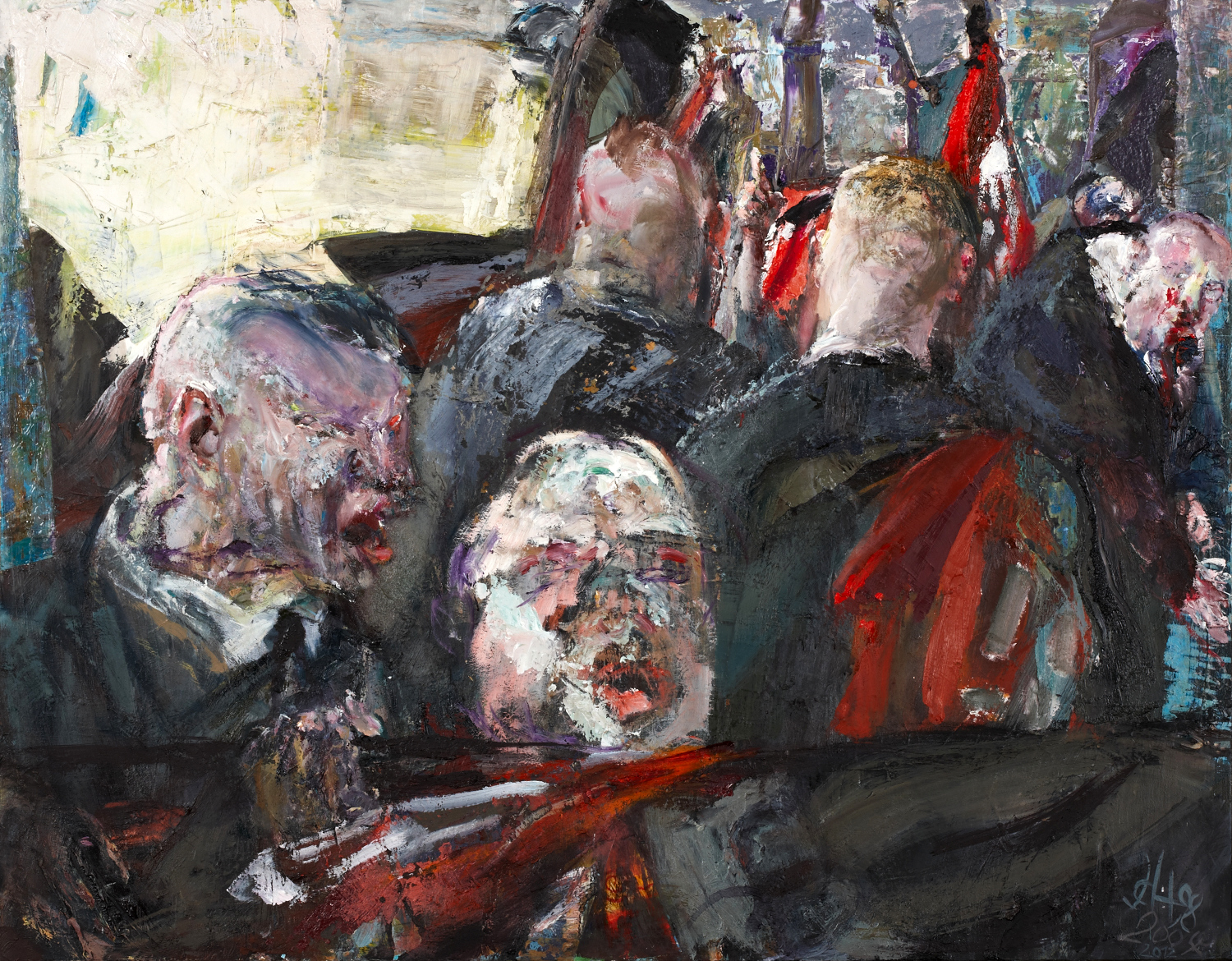
For the third time in a short period, GALERIE HIMMEL is presenting paintings by Johannes Heisig (2009–2013–2015). Heisig is one of the greats of the German art scene. If German museums weren't so cluttered with their possessions from the rich years of their acquisition budgets, we would find his paintings everywhere ! It is no exaggeration to say that, as a painter, he ties together threads from Corinth, Beckmann, Kokoschka and his father Bernhard Heisig. In his early years – he exhibited in Paris as early as 1982! – he quickly found his niche: the autonomous territory of Johannes Heisig. His desire for artistic freedom is his powerhouse, painting by painting. This exhibition shows it. He may have approached the empty canvas as a sceptic, but he left it with clarity for the moment of a new painting. It was probably a struggle, but in the end there is clarity and joy in forms and colours! In the current exhibition MONOLOGUES, viewers are presented with new works from the artist's three thematic areas: world inquiry – portrait – landscape/still life, and experience Johannes Heisig shortly after his sixtieth birthday with extraordinary paintings. Their forms and colours fly towards us from the canvas: power, restlessness, disturbance, clarity, impatience and disbelief. Despite all the drama, restlessness and fear in his paintings, one thing cannot be overlooked: the painter has a sense of humour. His NIGHT WATCHMAN looks cheekily out of the picture, not that he is laughing, but with his head posture and face, he can also be read as a rogue. It may be that the painter's humour has long since turned into gallows humour. At sixty, an artist does not become wise, and indeed, Heisig is obviously still constantly surprised. He is surprised by a mushroom cap that presses sensually into the cloth spread out beneath it with its weight; he is surprised by a bouquet of flowers on the slightly dented radiator cover, which in its old age is trying to compete with the nature outside the window; he is surprised by the wild power of a garden, as if it were saying, I can do without you. Of course, Johannes Heisig does not take the easy route when it comes to his world view. MAKE UP YOUR OWN MIND! is the title of this large-format exhibition. Since we have become accustomed, due to lack of time, to taking photographs as the truth and believing ourselves that we are really the ones in the selfie, this is the dictum of the hour: make up your own mind! With Heisig, one senses the struggle of many elements in his picture: individual truths float by in spheres and bubbles, pictures on the wall compete with the view from the window, accompanied by piano music, the image-tormented creature beams and is unable to decide on an interpretation. One of the spheres could be a fireball. It is on its way and could hit the figure at any moment. Form your own opinion! Before it's too late. In such thematic images, Heisig reveals more than ever his powerlessness in the face of the world. He doesn't know, he can only paint it. He doesn't finish his stories. Nor does he finish his paintings. He oscillates powerfully between Impressionism and Expressionism, freer than ever! He doesn't hide his thoughts, but paints them forcefully as waves crashing into the skyscraper canyon, he paints them as the joy of the curve of the railway tracks from the perspective of the rooftops. Roofs and viewing platforms have been his preferred location since the beginning of his career as a painter. He never believed that he could really get an overview from there. He has shown us mischievously and humorously that they are all standing in the lookout to discover the way to paradise from above or to take a photo, addicted to spectacle as they (we!) are. They (we!) have to try to get to the top. It is the familiar direction of movement in our days, and besides, there is a carnal crowd on the lawns. For Johannes Heisig, people in a crowd are the visual symbol of people in distress. If we could picture it, we would know how much we are in distress! Heisig's pictures touch the innermost regions of our fears and are at the same time pictorial events. We can duck down as those affected and say: Beautiful picture! Heisig then monologues with Rilke: For the (pictorial) beautiful is nothing but the beginning of the terrible...! Paul Klee provides the wording for Heisig's concept: Art does not reproduce the visible, but makes visible. Heisig starts from representation, but merges the image on the canvas with his inner monologue and his essence. The double meaning of ‘with his essence’ applies: that of the image and that of the artist! This is precisely what makes Johannes Heisig's visual art so essential. Essential for German contemporary art!
Michael Hametner