Introduction
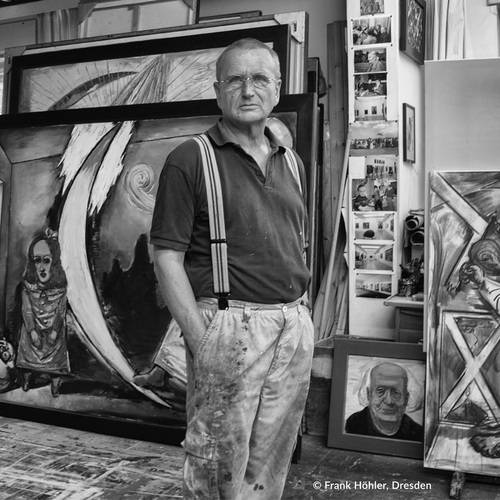
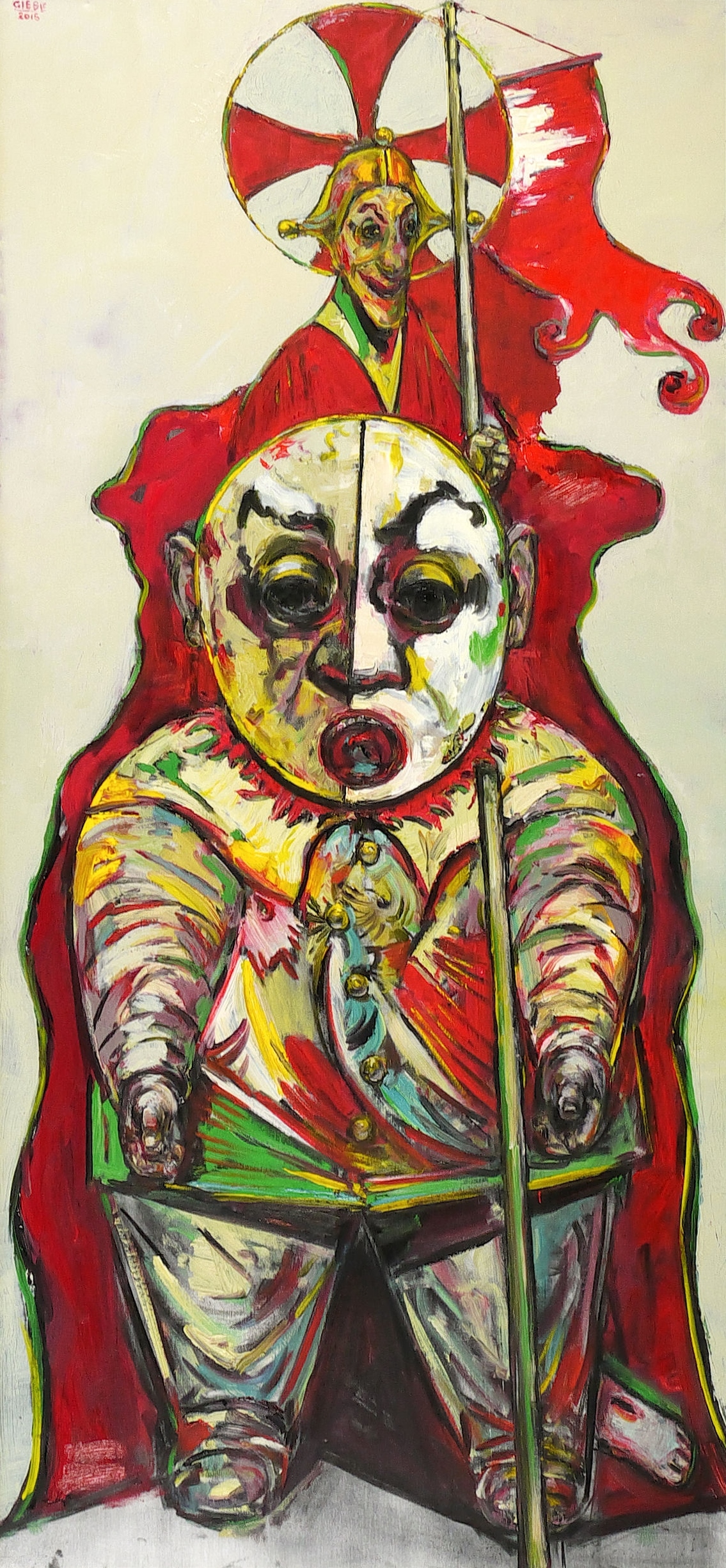
Someone like Hubertus Giebe, who sees himself as part of a great pictorial tradition and who has been fascinated and preoccupied with painting throughout his life, takes a stand in his pictures. His painting does not seek to be a reflection or model of the world, but rather holds up a mirror of existence to the viewer. External beauty and inner peace are also not Outward beauty and inner peace are also not the concern of the Dresden painter, draughtsman and graphic artist. His paintings are too unwieldy for that, with their surreal combination of montage, hyper-sharpness and simultaneous coexistence of pictorial figures and pictorial symbols, living from a »self-imposed mystification«, as the art historian Fritz Jacobi aptly remarked. Giebe works like a director who calls his actors and forces them into rooms. The figures are pushed in, their enigmatic, lethargic actions frozen. Hubertus Giebe understands the image as a medium through which taboo subjects, secrets and forgotten matters can be revealed. Personal experiences of suffering flow into his painting, as does the fundamental tragedy of human existence in modern times, as conveyed by literature, philosophy and history. Giebe is a highly interested and incredibly well-read person, an intellectual painter who is fascinated by the history of the Germans and, in particular, the history of individuals in the modern era. Giebe is a highly interested and incredibly well-read person, an intellectual painter who feels drawn to German history and especially to the history of individuals in the labyrinths of power. Time and again, it is about departure and breakup, rise and fall, power and powerlessness, violence and suffering of human beings, these infinitely fascinating creatures who are capable of senseless brutality as well as the highest sensitivity. In his ‘historical paintings’, Hubertus Giebe expressively and sharply accentuates the relevance of history. He emphatically addresses historical themes and expresses them in his paintings with strong personal involvement. It is not uncommon to feel that he himself is painfully involved in the midst of the horrors he paints. In general, he always seeks and finds people in historical spaces, exposed and helpless, confined in oppressively small pictorial frames. The painter fearlessly looks into the abysses of the human soul and reproduces what he sees there in metaphorical images that, even though they make us shudder, seem familiar to us. It is not only the inventory of a rich tradition of both literary and visual symbolism that seems familiar to us. It is the monsters and creatures of our own nightmares, it is our own fears and horrors that we encounter in his paintings. Apart from this Sisyphean task of »depicting history«, Hubertus Giebe formulates subjects such as portraits, nudes, landscapes and still lifes, a visual language that is no less forceful, no less demanding, determined by the same expressive style, the same powerful colouring, the same reduction of form and sharpening of contours. The artist's apparent kindred spirits in this regard are Picasso, Beckmann, Kokoschka and Dix. He repeatedly devotes himself to his immediate surroundings, varying the Hercules figures at the entrances to the Great Garden, internalising and condensing them. These paintings, but also those of the masks and seascapes, as seen in this exhibition, have something unsettling about them, which allows them to join in the chorus of the great historical dramas. This painting is powerful, disturbing and irritating at the same time, with a lasting, piercing intensity.