Introduction
Andreas Wachter studied at the Academy of Visual Arts in Leipzig from 1974 to 1980 under Arno Rink and Volker Stelzmann. In his artistic oeuvre, which he has been consistently developing for four decades, his drawing skills, honed in Leipzig, are combined with an extraordinary colourism of his own distinctive style, evident in his use of colour and composition. His four decades of consistent painting combine the drawing skills he learned in Leipzig with an extraordinary colourism of his own, clearly inspired by a profound knowledge of art history.
The distinctive style and intense imagery characterise one of the most personal voices to emerge from the Leipzig School. Far removed from the conventional concept of a school and in contrast to other artistic positions, Wachter occupies an outsider role in the art world. Not least because his seemingly oldmasterly painting has a contemporary relevance without an avant-garde attitude.
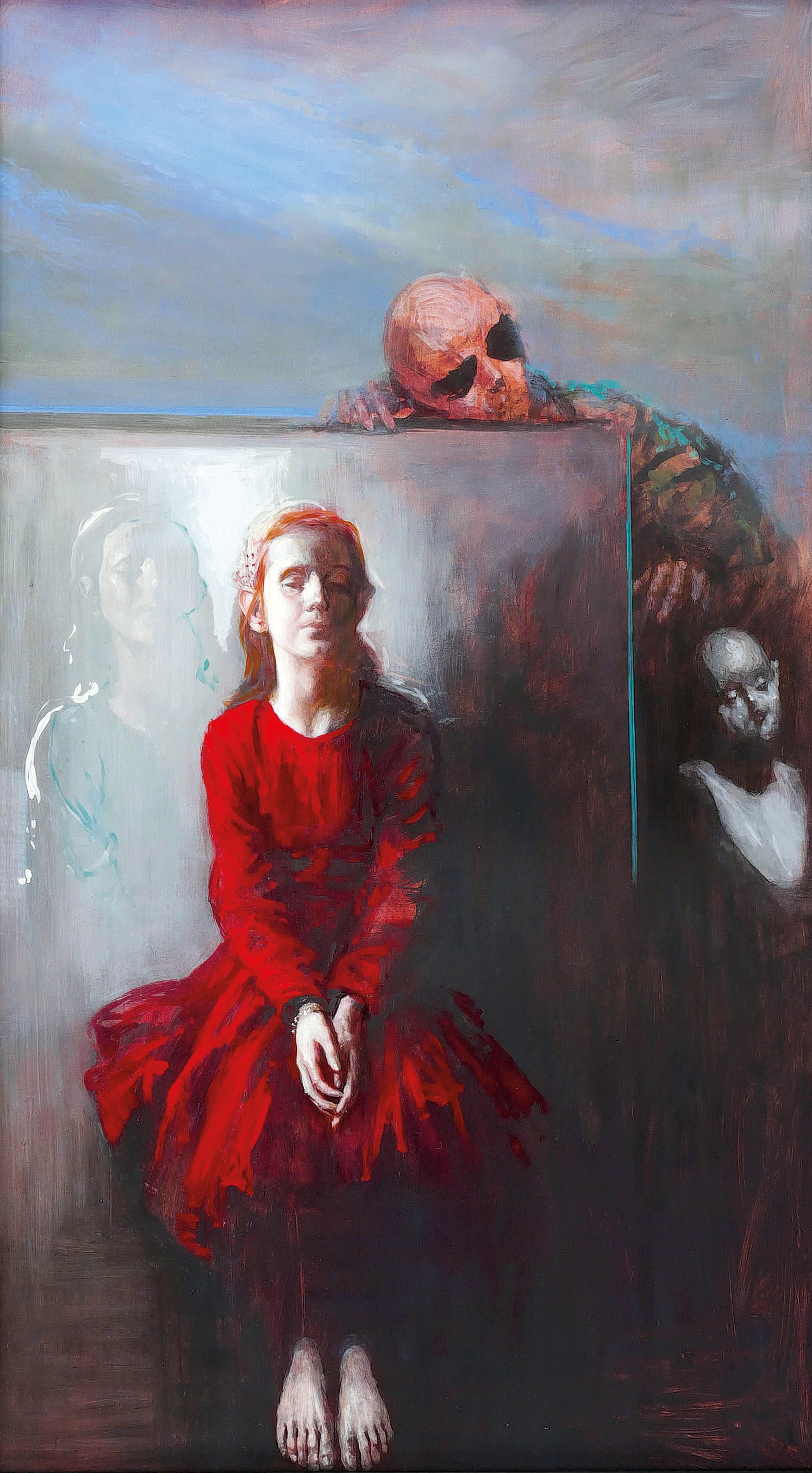
Wächter's painting seduces the eye. In glazed layers of colour that glow from within, a dominant yet harmonious colour scheme is expanded and contrasted by sharper tones, such as red or green. A special lighting design in the style of Venetian Mannerists or the A special lighting technique in the style of Venetian Mannerists or Roman Baroque creates a dramatic chiaroscuro that places light-flooded areas in direct contrast to night-black darkness. In contrast, overly sharp outlines are reined in in favour of a sculptural shaping of the pictorial objects. Figures are often only sketched out and appear in a vague manner.
Figures and landscapes are central to Andreas Wachter's work. In scenarios that are sometimes observed and sometimes invented, figures encounter one another, bringing interiors, street scenes or expansive landscapes of longing to life with restrained theatricality. They appear introverted, opening up rather cautiously. Sometimes they act as if they are strangers to one another, as if they are aiming for a hidden dramatic goal. Thus, a narrative plot emerges only in its early stages. Sometimes they act as if they are strangers to one another in the space, as if they are focused on a hidden dramaturgical goal. A narrative plot thus only becomes apparent in fragments and is more intuited than named. As if woven together by a metaphysical thread, these scenarios refer to something transcendental.
The artist has placed individual figures in bright light, elaborating them in rich detail and with precision. They draw the viewer's gaze directly to themselves. Others elude the viewer, turning away, overlapping, viewed from below, fragmented or shadowed by darkness. For the most part, the figurative elements are perceived as sculptural and corporeal , seemingly borrowed from a tangible reality. But contemporary types, such as models from the private sphere, are mixed with artistic creations from an imaginary repertoire of antique collections and art galleries. The art critic Klaus Jörg Schönmetzler therefore saw Wachter »[...] living in all these styles, in these times themselves. As if the present were not enough for him to create the echo chamber he needs for his pictures. As if only through the addition and superimposition of times were it possible to say what he has been given to say.«
Andreas Wachter does not paint parables. At most, his pictures convey states of mind that can only be experienced personally and expressed indirectly. They deal with something substantial, nothing concrete, banal or even literary. His paintings cannot be deciphered, do not want to be emptied of meaning through translation. Their secret is above all one thing: this wonderful, sensual and virtuoso painting, celebrating the pictorial knowledge of centuries, always posing the question of illusion and reality.